ACUTE MEDICINE · DIAGNOSTIC REASONING · CPD-ACCREDITED TEACHING
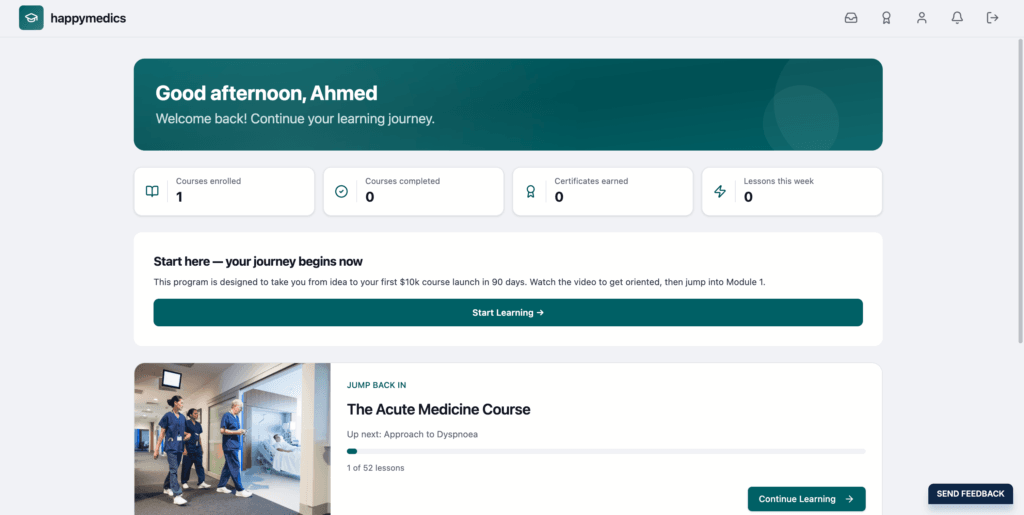
The Acute Medicine Course
A more systematic way to approach the acute take.
Learn to assess, investigate and manage common acute medical presentations through structured diagnostic frameworks, clinical teaching and real case-based discussions.
Move beyond simply recognising familiar patterns. Develop an organised approach to the patients who aren’t immediately straightforward.
7
clinical modules
14
diagnostic frameworks
14hrs
recorded teaching
Live
case discussion
25
CPD points (up to)
A FAMILIAR CLINICAL SITUATION
You have the clinical
knowledge. But what happens
when the presentation isn’t
straightforward?
Imagine assessing a 76-year-old man admitted with worsening breathlessness. He has COPD, heart failure with preserved ejection fraction, type 2 diabetes and chronic kidney disease. He’s tachypnoeic at 32 breaths per minute, with an oxygen saturation of 96% on room air. On examination, there’s mild wheeze and bilateral peripheral oedema. His chest X-ray shows no convincing consolidation or pulmonary oedema. But his blood results reveal something interesting. A venous blood gas demonstrates a pH of 7.24, bicarbonate of 13 mmol/L and lactate of 1.2 mmol/L. His creatinine has risen from a baseline of 150 to 290 µmol/L.
So what’s actually driving his breathlessness?
Is this primarily a respiratory problem? Could he have decompensated heart failure despite the relatively unremarkable chest X-ray? Or is his increased respiratory rate partly a compensatory response to the metabolic acidosis? And what caused the acute kidney injury in the first place? These aren’t mutually exclusive possibilities. Several processes may be contributing to the same presentation. And the decisions aren’t necessarily straightforward either. Does he need fluid resuscitation? Could that worsen cardiac congestion? Are there metabolic complications requiring immediate treatment?
Where do you start, and how do you decide what matters most?
This is the reality of acute medicine. Patients frequently present with multiple comorbidities, overlapping pathologies and investigations that need to be interpreted together. The challenge isn’t simply remembering the differential diagnosis for breathlessness. It’s understanding the physiology, organising the competing explanations, identifying the immediate priorities and using the available evidence to determine what should happen next.
That’s where having a systematic approach becomes particularly valuable.
Not because a framework automatically gives you the answer. But because it gives your clinical reasoning a clearer direction.
WHO IS THIS FOR?
You’ve probably encountered
this already.
You know how to assess a patient and take an appropriate history.
You’ve studied the guidelines and understand the investigations.
But certain presentations still require more conscious effort to organise.
01
Perhaps you recognise a likely diagnosis quickly, but want to make sure you haven’t overlooked an important alternative.
02
Perhaps you’re comfortable generating a differential, but would like a more logical way to prioritise it.
03
Or perhaps you’ve watched an experienced clinician work through a complex case and wondered how they arrived at a sensible plan so efficiently.
That’s exactly the kind of clinical thinking we’re going to explore.
WHAT CHANGES
Imagine approaching your
next acute take with a clearer
structure.
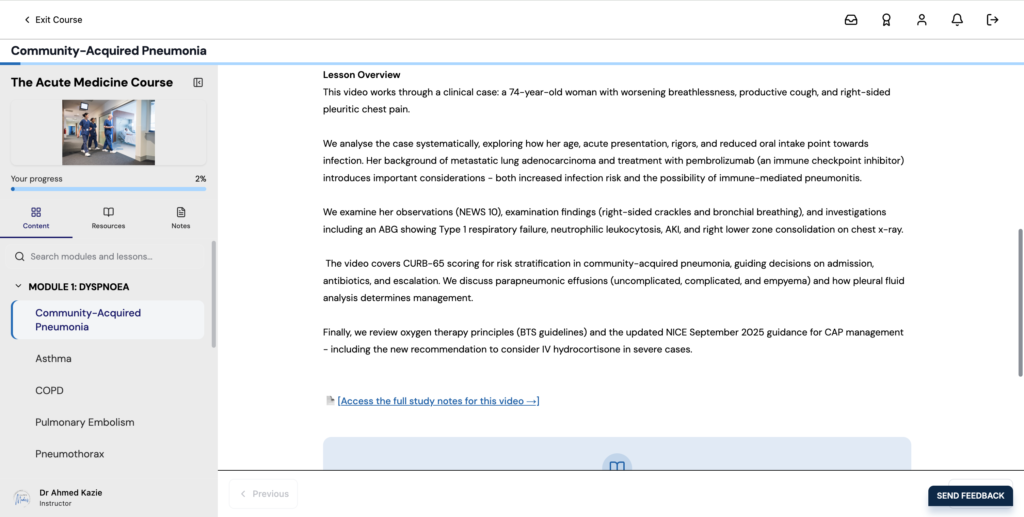
You assess a patient with chest pain.
Rather than trying to recall a long list of possible diagnoses, you have an organised way to consider the likely causes and the important time-critical alternatives.
Not every patient will be straightforward. And a framework won’t automatically give you the correct diagnosis.
But you’ll have a structured approach to work through the uncertainty.
That is what the Acute Medicine Course is designed to teach.

WHAT MAKES THIS COURSE DIFFERENT
The clinical frameworks are at the heart of the course.
Instead of organising the teaching around individual diseases, the course begins with the problems patients actually present with.
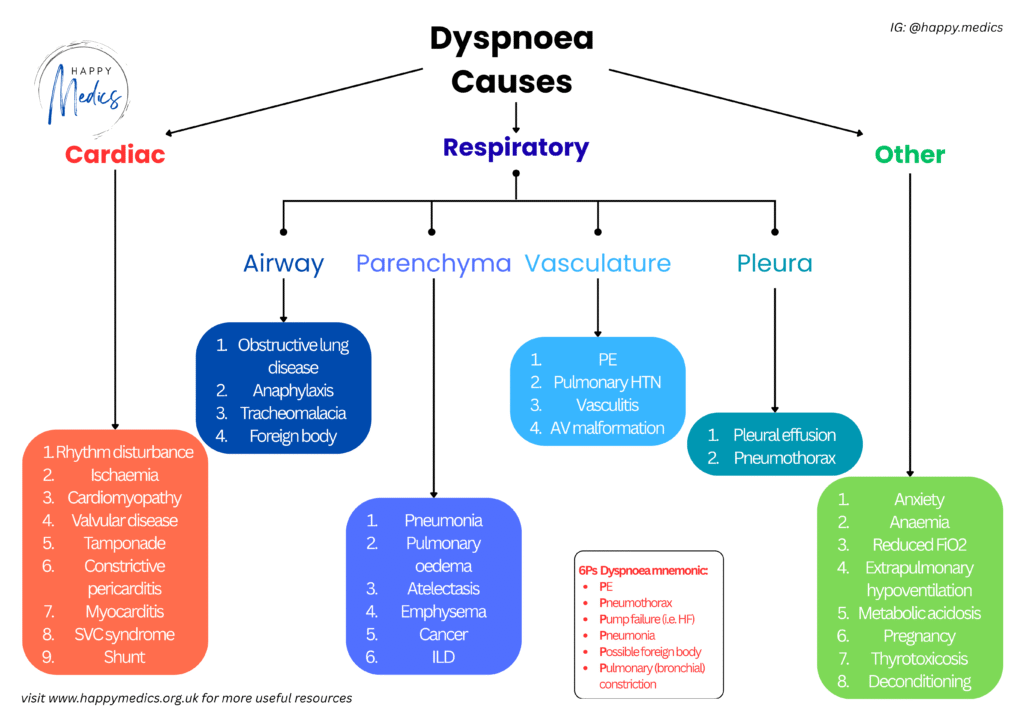
Dyspnoea
Chest Pain
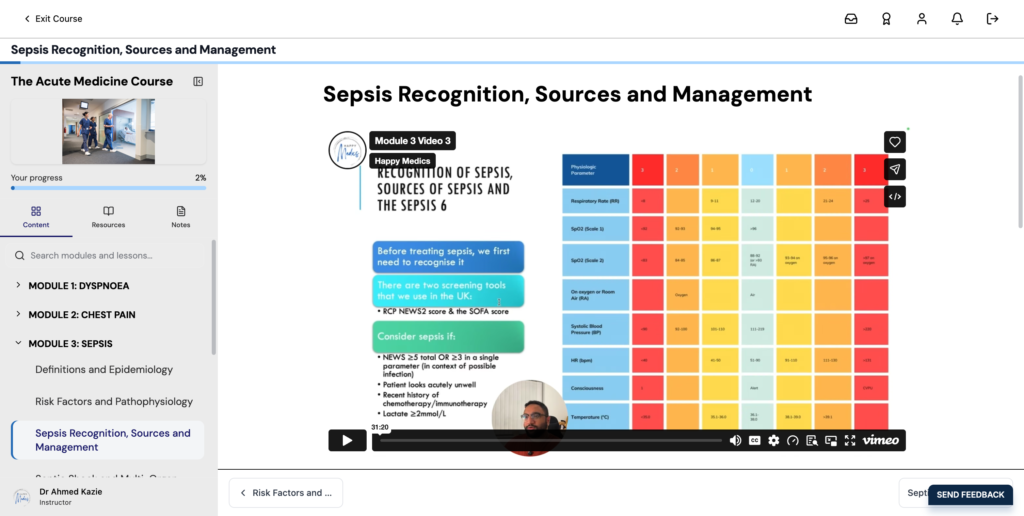
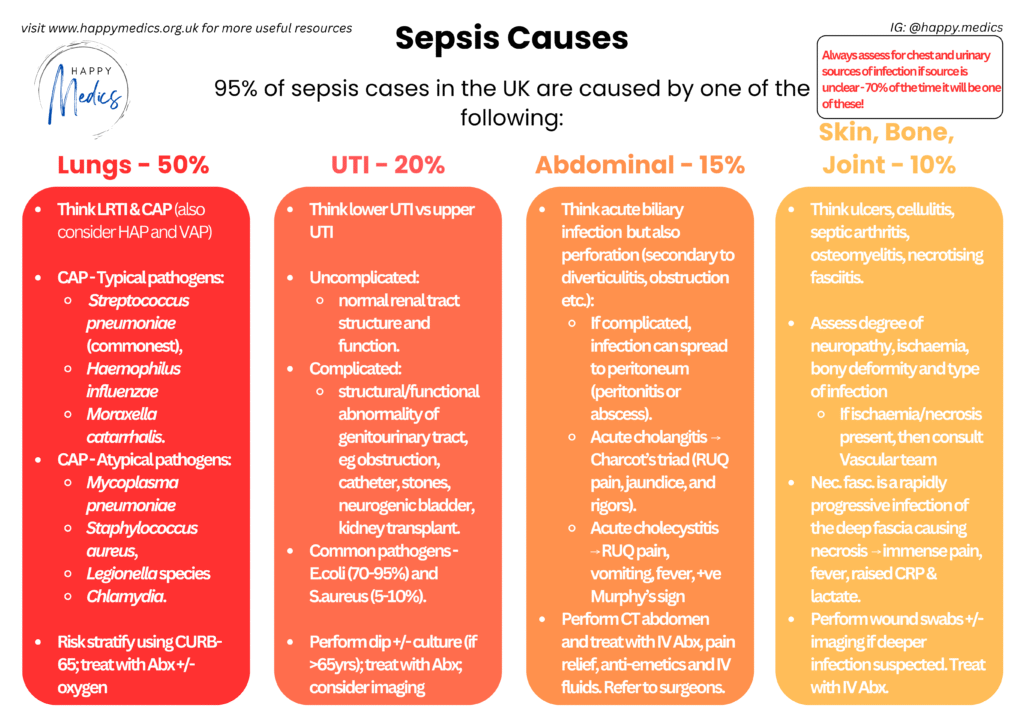
Sepsis
Headache
GI Bleed
Collapse
Electrolytes
Each presentation is explored using a structured diagnostic framework, supported by physiology, pathology, clinical evidence and relevant national guidance.
01
Organise the differential
Perhaps you recognise a likely diagnosis quickly, but want to make sure you haven’t overlooked an important alternative.
02
Recognise what matters
Perhaps you’re comfortable generating a differential, but would like a more logical way to prioritise it.
03
Think through the next decision
Or perhaps you’ve watched an experienced clinician work through a complex case and wondered how they arrived at a sensible plan so efficiently.
And then we practise applying these principles to clinical cases. Because understanding a framework is one thing.
But knowing how to use it when the clinical picture changes is where the teaching becomes particularly valuable.
OUR REVIEWS
What previous learners have said

“Very clear and thorough teaching, excellently presented.“
Dr Chandrabose
Renal Registrar
“It’s an essential course for all transitioning medics. It helped me to think independently and focus on patholophysiology of topics.”
Dr Adams
GPST
“It helped us to think independently and focus on patholophysiology of topics.”
Dr Boban
GPST
92.9%
said the course exceeded or far
exceeded their expectations.
85.7%
Rated likelihood of
recommending 9–10/10
4.86/5
Average framework
usefulness rating
100.0%
Learners reporting
increased confidence
INSIDE THE COURSE
Seven modules. The
presentations you encounter on the acute take.
Every module combines clinical teaching with a structured way to approach the presentation, from the initial assessment to subsequent diagnostic and management decisions.
MODULE 01
Dyspnoea
Learn to reason through cardiac, respiratory and systemic causes of breathlessness, including pneumonia, heart failure, pulmonary embolism and obstructive airway disease.
MODULE 02
Chest Pain
Understand how to approach chest pain through its clinical characteristics, recognise important time-critical diagnoses and interpret investigations in context.
MODULE 03
Sepsis
Learn to reason through cardiac, respiratory and systemic causes of breathlessness, including pneumonia, heart failure, pulmonary embolism and obstructive airway disease.
MODULE 04
Headache
Understand how to approach chest pain through its clinical characteristics, recognise important time-critical diagnoses and interpret investigations in context.
MODULE 05
GI Bleed
Learn to reason through cardiac, respiratory and systemic causes of breathlessness, including pneumonia, heart failure, pulmonary embolism and obstructive airway disease.
MODULE 06
Collapse +/- LOC
Understand how to approach chest pain through its clinical characteristics, recognise important time-critical diagnoses and interpret investigations in context.
MODULE 07
Electrolyte Disturbances
Understand common electrolyte abnormalities through clinical physiology and structured approaches to investigation, treatment and monitoring.
THE LEARNING EXPERIENCE
It’s not just the frameworks. It’s
how we learn to use them.
The Acute Medicine Course combines three complementary forms of teaching..
Step 1
Learn the underlying medicine
The on-demand video library explores the clinical knowledge behind the presentations, including relevant physiology, pathology, investigations and evidence-based management.
Step 2
Build a systematic approach
Downloadable diagnostic frameworks provide an organised way to review the important possibilities and support your clinical reasoning.
Step 3
Apply it to clinical cases
During the live teaching, we work through cases and discuss how additional clinical information changes the differential, the interpretation of findings and the next decision.
Rather than simply revealing the answer, we explore the thinking that gets us there.
What learners have valued
“The course is structured in extremely good way and covers all pathologies doctors do not want to miss on take. The frameworks are well-written and presented. Dr Kazie’s course is engaging and comprehensive.”
Dr Rymberg
IMG
“Good structure and slides – very good at explaining the framework and how best to work through each scenario in a stepwise approach”
Dr Man
JCF
“Clear explanations. Step by step review of clinical cases. Extensive content available online.”
Dr Vanam
JCF
EVERYTHING INCLUDED
Choose how much of the acute take you’d like to cover.
ACUTE MEDICINE COURSE
Basic
A focused introduction to the framework-based approach, covering three core acute medical presentations.
£150
For doctors who want to concentrate on three important presentations.
ACUTE MEDICINE COURSE
Pro
The full learning programme, covering seven acute medical presentations and the complete collection of diagnostic frameworks.
£270
Recommended for doctors who regularly assess undifferentiated acute medical patients and want the full programme.
Both options are designed to complement your ongoing clinical training and practice.
WHAT LEARNERS ACTUALLY THOUGHT
Don’t just take my word for it.
Doctors from different training backgrounds have completed the Acute Medicine Course, including foundation doctors, SHOs, internal medicine trainees, GP trainees, international medical graduates and medical registrars. Here’s what some of them said.
On the frameworks
“Frameworks incorporate first-principles thinking that allows for systematic thought process over pattern recognition”
Dr Malik
FY1
“I really enjoy the framework style; it makes the logic behind decisions much clearer. I’ve seen similar styles in ALS/ATLS, but applying it specifically to medical presentations like this is quite refreshing.”
Dr Fawad
FY2
“The most beneficial aspect of the course is the differential diagnosis and mapping.”
Dr Boutrous
IMG
On the teaching
“The frameworks are well-written and presented. Dr Kazie’s course is engaging and comprehensive.”
Dr Rymberg
IMG
“The course is practical, engaging and immediately relevant to day-to-day clinical work. The live sessions are excellent…”
Dr Chijioke
JCF
“Very clear and thorough teaching, excellently presented.”
Anonymous
Medical Registrar
On clinical relevance and value
“I enjoy the acute medicine frameworks very much and so useful when working in acute or on call setting”
Dr Aslam
IMT
“My critical thinking has improved. I can see how the concepts apply to real patients, not just theory.”
Dr Nabiil
JCF
“I had my own way of working through cases, but this gave me a structure I can actually rely on, especially when the presentation isn’t textbook.”
Dr Anjana
JCF
WHAT YOU TAKE INTO PRACTICE
What might you do differently after the course?
The course is designed to help you develop habits that continue beyond the teaching itself. You may find yourself:
These skills develop through continued clinical experience as well as formal teaching.
The aim isn’t to replace the judgement you’re developing through your training.
It’s to give you a more organised way to develop and apply it.
THE ALTERNATIVE
You can continue building this approach through experience alone.
And clinical experience will always remain essential.
You’ll continue encountering new presentations, reviewing guidelines and learning from colleagues.
But if you specifically want a structured way to bring that learning together, the Acute Medicine Course provides an opportunity to develop one deliberately.
Rather than assembling an approach to each acute presentation from separate resources, you can work through a cohesive programme designed around those clinical problems.
WHO THIS COURSE IS FOR
Is the Acute Medicine Course right for you?
Registrar
SCF
IMT
JCF
GPST
ACCS
Foundation
IMG
This course is particularly relevant if you regularly encounter acute medical presentations.
It’s especially suitable if you enjoy learning through clinical reasoning, want to understand the rationale behind investigations and management, and value an organised approach to undifferentiated patients.
It may be less suitable if you’re looking purely for an examination question bank, a procedural skills course or a short revision resource covering a single diagnosis.
The programme offers educational frameworks and case-based teaching. It does not substitute for clinical supervision, local protocols or practising within your competence.
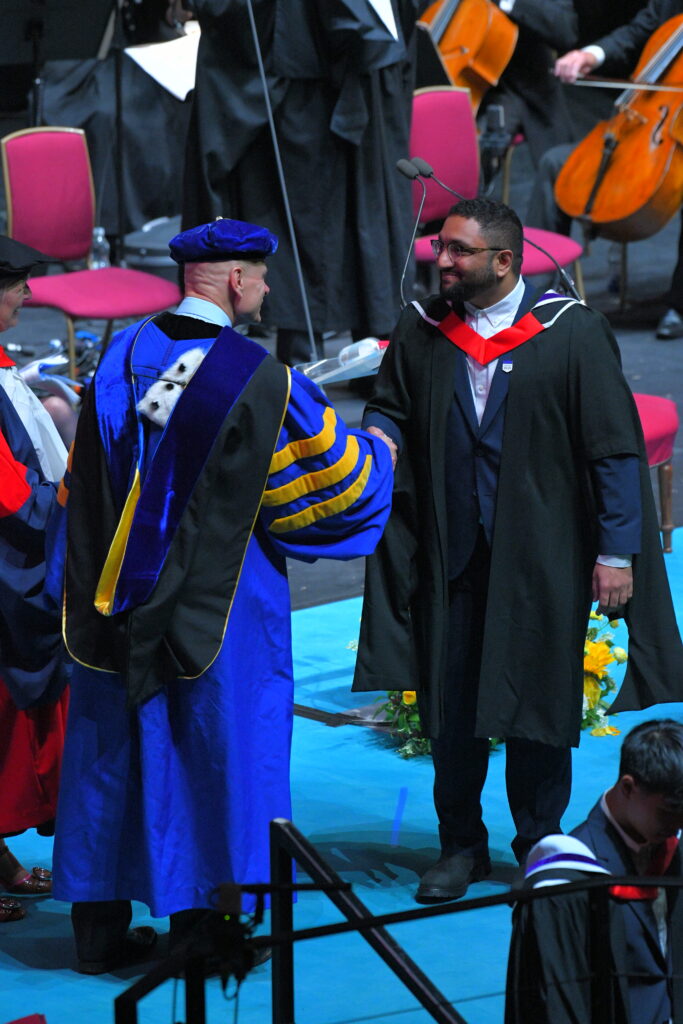
MEET YOUR EDUCATOR
Hi, I’m Dr Ahmed Kazie.
I’m an Acute Medicine Doctor working in the NHS and the founder of Happy Medics.
One of the things I’ve always found valuable about excellent clinical teaching is hearing how another doctor actually thinks.
Not simply which diagnosis they reached, but how they approached the patient, which findings they considered important and what made them change their initial impression.
That’s the kind of teaching I wanted to build.
The Acute Medicine Course brings together common acute presentations, clinical physiology, pathology, published evidence and my own diagnostic frameworks.
Throughout the course, my aim is to make the clinical reasoning explicit.
I want you to understand not just what we do in acute medicine, but why we do it.
QUESTIONS
Frequently asked questions
Q. How is this different from other acute medicine courses?
The course is organised around the presenting clinical problem rather than teaching diseases only in isolation.
Each module combines clinical teaching with a diagnostic framework, giving you a way to organise the differential and understand the reasoning behind investigations and management.
Q. Will I benefit me if I’m already working as a registrar?
The teaching is designed to be relevant across several training stages.
The value depends on your existing knowledge and experience, but experienced doctors especially tend to find it helpful to explore alternative ways of structuring familiar clinical problems.
Q. Is this mainly an MRCP revision course?
No. Although much of the medicine may be relevant to postgraduate examinations, the primary focus is applying clinical knowledge to acute presentations.
Q. Can I study around my rota?
Yes. The recorded content is available on demand throughout your access period.
Live teaching is scheduled separately, and the relevant joining arrangements are provided to enrolled learners.
Q. What if I can’t attend the live sessions?
Learners who cannot attend a live session within their course access period (6 months for Basic & 12 months for Pro) will be offered attendance with a subsequent cohort. Please email if there are any issues relating to booking your live session date: queries@happymedics.org.uk
Q. Is the course CPD accredited?
The course is accredited by CPD UK, with up to 10 CPD points for Basic and 25 for Pro, subject to the relevant participation and certification requirements.
Q. How long will I have access?
Six months for Basic and twelve months for Complete under the current course arrangements.
Q. Does the course guarantee that I’ll become better at diagnosing patients?
No educational programme can guarantee a particular clinical outcome.
The course aims to help you develop knowledge, structured reasoning and practical approaches that you can continue refining through clinical experience.
Q. What is the refund policy?
Please email us within 14 days of purchase to process a partial refund
Bring more structure to your next acute take.
You already have a growing body of clinical knowledge.
The Acute Medicine Course is an opportunity to organise that knowledge around the patients you actually encounter—and practise the reasoning behind the decisions you make.
Choose the focused Basic course or the complete Pro programme.
Join 100s of UK Medics
200+ Reviews